
Academia Sinica: YOLOv9
YOLOv9 Overview
YOLOv9 is a real-time object detection model developed by Chien-Yao Wang and Hong-Yuan Mark Liao at Academia Sinica, released in February 2024 under the GPL-3.0 license. It introduces Programmable Gradient Information (PGI), a mechanism that preserves complete input information through auxiliary reversible branches during training to address information loss in deep network layers. It also introduces the Generalized Efficient Layer Aggregation Network (GELAN), which achieves better parameter utilization compared to prior CSP-based designs.
YOLOv9-C achieves 53.0% AP on COCO with 42% fewer parameters and 21% less computation than YOLOv8-C at comparable accuracy. YOLOv9-E achieves 55.6% AP. The model is deployable through Roboflow Inference and supports fine-tuning via the standard training pipeline in the official repository.
YOLOv9 Explained
YOLOv9 is an open source computer vision model for real-time object detection and image segmentation. It uses the YOLOv9 architecture introduced by Chien-Yao Wang and collaborators, with a focus on preserving information in deep networks and improving computational efficiency through Programmable Gradient Information (PGI) and the Generalized Efficient Layer Aggregation Network (GELAN).
YOLOv9 is a single-stage detector that supports both object detection and image segmentation. The architecture is designed for real-time performance while maintaining high accuracy on benchmarks such as MS COCO.
According to the YOLOv9 research team, the architecture achieves higher mean Average Precision (mAP) than earlier popular YOLO variants, including YOLOv8, YOLOv7, and YOLOv5, when evaluated on the MS COCO dataset.
Key architectural characteristics include:
- Support for object detection and image segmentation tasks.
- Real-time inference focus, with design choices that balance speed and accuracy.
- Integration of PGI and GELAN to address information loss and improve parameter and compute efficiency.
Information Bottleneck Principle
The Information Bottleneck Principle describes how information is lost as data passes through layers of a deep neural network. It uses mutual information to quantify how much of the original input information is preserved after transformations.
In the Information Bottleneck formulation:
- Mutual information between the original data and transformed representations decreases as data moves through deep layers.
- This loss of crucial information can lead to unstable gradients and poor convergence.
A common response is to increase model size to improve capacity. This can preserve more information but does not fully solve the problem of unstable gradients in very deep networks.
📷 ADD IMAGE: Conceptual diagram of the Information Bottleneck equation and information flow through deep network layers

Reversible Functions
Reversible functions are introduced as a theoretical solution to the Information Bottleneck problem.
- A reversible function allows exact reconstruction of the input from the output.
- In the reversible formulation, forward and reverse transformations have their own parameters, and no information is lost during transformation.
- Embedding reversible functions in neural networks allows all input information to be retained across layers.
This leads to more reliable gradient computation during training and changes the usual assumptions about how deep networks must be structured, especially for complex tasks where models are not originally designed to be very deep.
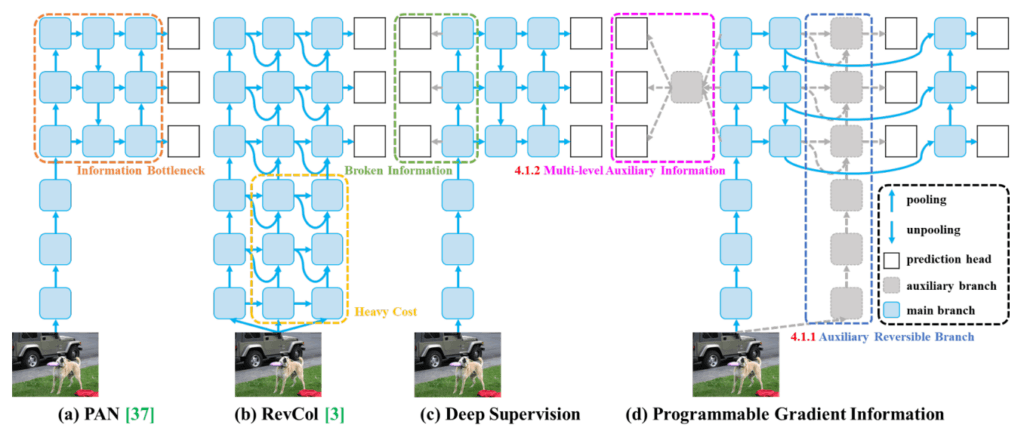
Programmable Gradient Information (PGI) is introduced to provide dependable gradients for training while remaining compatible with shallow and lightweight networks.
PGI has three main components:
Main Branch
- Optimized for inference.
- Operates without auxiliary components during deployment.
- Maintains high performance without extra computational overhead at inference time.
Auxiliary Reversible Branch
- Uses reversible architecture to compute accurate gradients during training.
- Mitigates information loss in deep layers by preserving complete data for learning.
- Can be integrated or removed without affecting inference speed, since it is not required at deployment.
Multi-Level Auxiliary Information
- Uses specialized networks to combine gradient information from multiple layers.
- Addresses information loss in deep supervision setups.
- Improves prediction quality for objects at different scales.
During training, PGI provides a structured way to program gradient information through the network, improving stability and effectiveness without adding cost at inference.
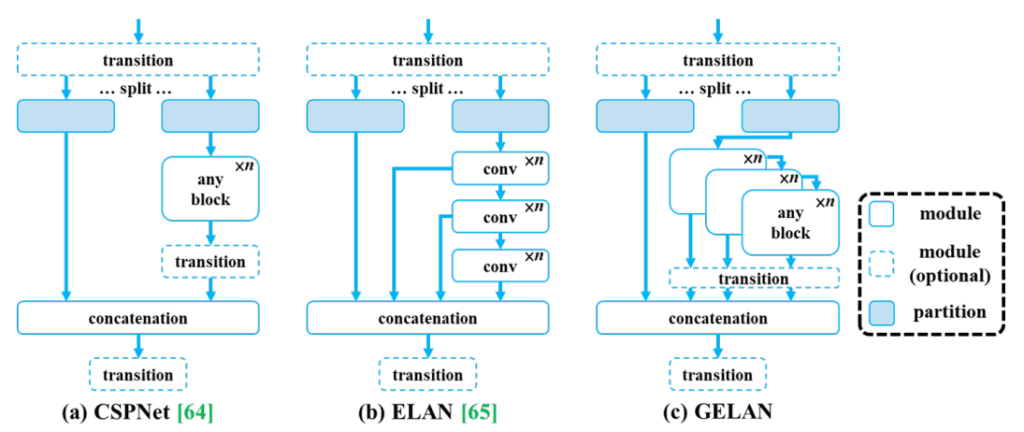
The Generalized Efficient Layer Aggregation Network (GELAN) is introduced to further improve accuracy and efficiency once PGI is in place.
GELAN is designed to complement PGI by providing a flexible and efficient backbone structure that can host different computational blocks.
In YOLOv9, GELAN:
- Combines gradient path planning ideas from CSPNet.
- Incorporates inference speed optimizations from ELAN.
- Maintains a lightweight design that prioritizes fast inference while preserving accuracy.
This combination extends the real-time inference strengths associated with the YOLO family while improving parameter utilization and computational efficiency.
YOLOv9 is compared against several real-time object detectors on the MS COCO dataset, including YOLO MS variants, YOLOv7 AF, and YOLOv8-X.
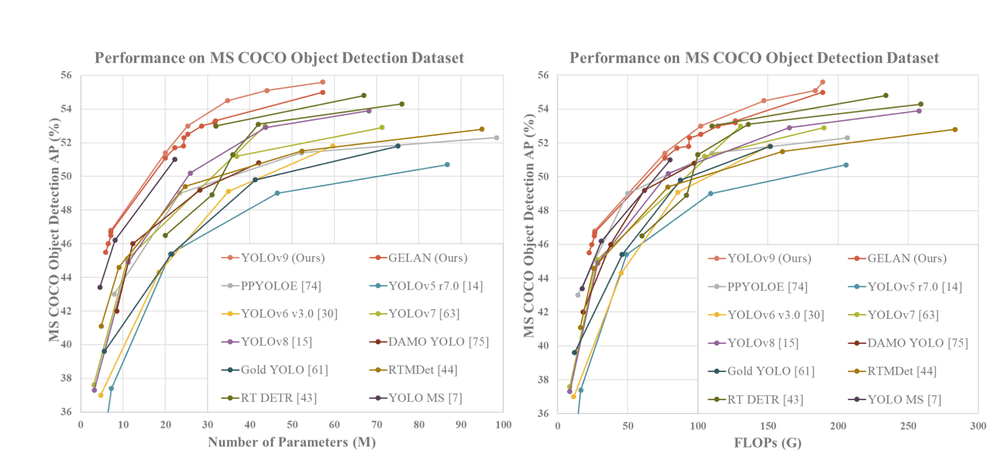
The reported comparisons include:
- Against YOLO MS for lightweight and medium models:
- Approximately 10% fewer parameters.
- About 5% to 15% fewer computations.
- Around 0.4% to 0.6% higher Average Precision (AP).
- Against YOLOv7 AF (general models):
- YOLOv9-C has about 42% fewer parameters.
- About 22% fewer computations.
- Similar AP of about 53%.
- Against YOLOv8-X (large models):
- YOLOv9-E has about 16% fewer parameters.
- About 27% fewer computations.
- AP improvement of about 1.7%.
These comparisons indicate that YOLOv9 improves AP while reducing parameter count and computational cost relative to several prior YOLO-based detectors.
YOLOv9 is designed to be trained and deployed as a real-time detector and segmenter across a range of applications.
Key practical points derived from the architecture design:
- Training uses PGI, with:
- A main branch that matches the deployed inference graph.
- An auxiliary reversible branch that is active during training to provide accurate gradients.
- Multi-level auxiliary supervision that improves learning across scales.
- Deployment uses only the main branch:
- The auxiliary reversible branch and auxiliary nodes are removed.
- Inference cost is similar to a conventional lightweight YOLO-style model with GELAN as the backbone.
Because GELAN is lightweight and PGI’s auxiliary components are only used during training, YOLOv9 is suitable for real-time inference scenarios where both speed and accuracy are important, such as video analytics and embedded vision, while maintaining efficient parameter and compute usage.
Alternatives to YOLOv9
Other models worth comparing for similar use cases.


YOLOv9 License
GPL-3.0 · Restrictive licenseYOLOv9 is released under GPL-3.0, a restrictive license. The YOLOv9 license permits commercial use, but it requires you to open-source any code changes you make, so businesses that cannot release related code need a separate commercial license.
- Commercial use
- Permitted with obligations: you can sell products built on YOLOv9 only if you also release the corresponding source under GPL-3.0. A commercial license removes that obligation.
- Modification
- Permitted. Modified versions you distribute must be released under GPL-3.0, with your changes documented.
- Redistribution
- Permitted with the corresponding source code and the license text.
Uncertainty around licensing can delay or stop a project. If you are commercially unwilling or legally unable to open-source related code, settle the YOLOv9 licensing question before you build on it, not after.
Read the full GPL-3.0 license ↗Do I need a commercial license for YOLOv9?
In practice, distributing YOLOv9 in a commercial product means releasing your application's source code under GPL-3.0. Need a permissive license? RF-DETR is Apache 2.0.
Do not hesitate to reach out with questions for your commercial project — our team will help you start solving business problems on the first call. See Roboflow commercial licensing for the models included in each plan.
Talk to salesYOLOv9 is released under GPL-3.0. In practice, distributing it in a commercial product means releasing your application's source code under GPL-3.0.
Using YOLOv9 commercially means complying with GPL-3.0, which requires releasing your application's source code if you distribute it, or getting a separate license from its authors. Need a permissive license? RF-DETR is Apache 2.0.
GPL-3.0 is a "copyleft" license: distributing a product that includes this model typically requires you to release your full source code under GPL-3.0.
YOLOv9 is **not covered by Roboflow's commercial sub-license arrangements**. To use it commercially, you must comply with its upstream GPL-3.0 terms directly or obtain a separate license from its authors. See the Roboflow Licensing guide for which models are covered.
License information is provided as a guide and is not legal advice.